
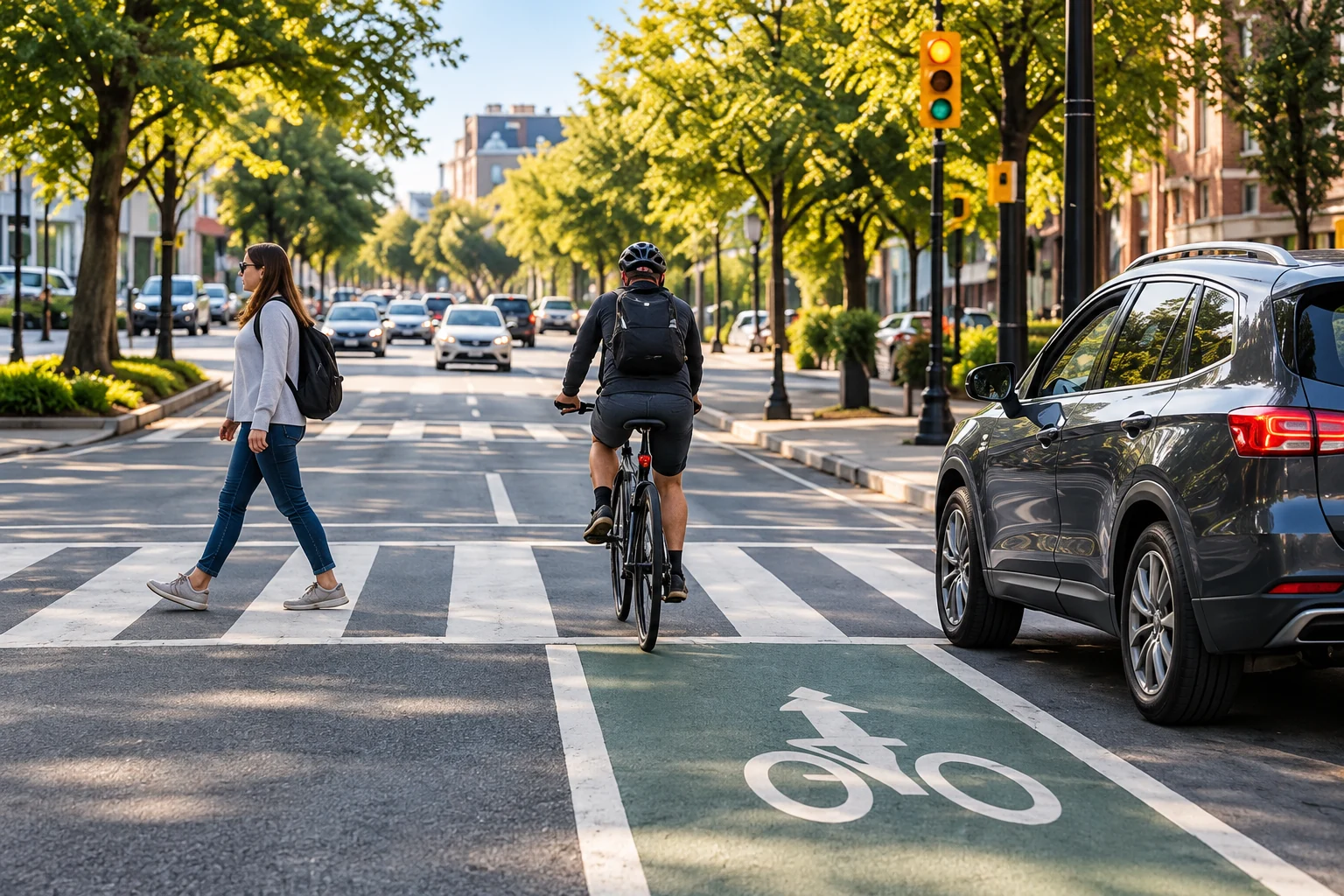
Imagine an ordinary intersection with a turning lane, a marked crossing, and a bicycle route approaching the corner. This is an illustrative example, not a reconstruction of a particular crash. A driver, a cyclist, and a person walking can occupy the same place while seeing different parts of the situation.
From the driver’s seat
The driver may be looking for a gap in approaching traffic while preparing to turn. At the same time, a person could be approaching the crossing from another direction. A useful observation includes the intended path through the junction and the people who may use that path, not just the vehicles coming toward it.
In its pedestrian-safety guidance, NHTSA advises drivers to look for pedestrians, prepare to stop when turning through crossings, and avoid passing a vehicle stopped at a crosswalk. A stopped vehicle can conceal information about the space beyond it. Its presence is a reason to understand the situation before proceeding.
From the bicycle
The cyclist may be following a lane that changes position or ends near the intersection. Surface conditions, parked vehicles, and turning traffic can all be relevant to the route through it. A driver’s view of an apparently clear strip of pavement does not explain every consideration affecting the rider’s position.
NHTSA’s bicycle-safety guidance emphasizes predictable movement, following signs and signals, and anticipating hazards. The details of bicycle facilities and local rules vary, so a photograph of one intersection cannot establish a universal rule for where every cyclist should ride.
From the crossing
A pedestrian may be trying to understand whether an approaching driver has noticed the crossing, whether a signal applies, or whether a stopped vehicle blocks the view of another lane. A person using a wheelchair or moving with a child may also experience the available space differently from someone viewing the junction through a windshield.
The road layout matters alongside individual choices. The FHWA intersection-safety manual discusses sight distance as a part of assessing an intersection. The ability to see approaching traffic is a design consideration, not something that can be fully judged from a single casual observation.
Use the different views as questions
- What can each road user see from their actual position?
- Where do intended paths meet or cross?
- Which signs, signals, and markings apply to each movement?
- Could another vehicle or part of the street obscure someone’s view?
These questions are a way to understand a shared space. They do not establish fault or diagnose the safety of a particular junction. A full assessment requires more information about conditions, movements, controls, and the location itself.
Continue with why a turning truck needs additional space or how to read a roundabout before entering. Both topics become clearer when you consider the entire movement of each road user, including the parts you cannot immediately see.