
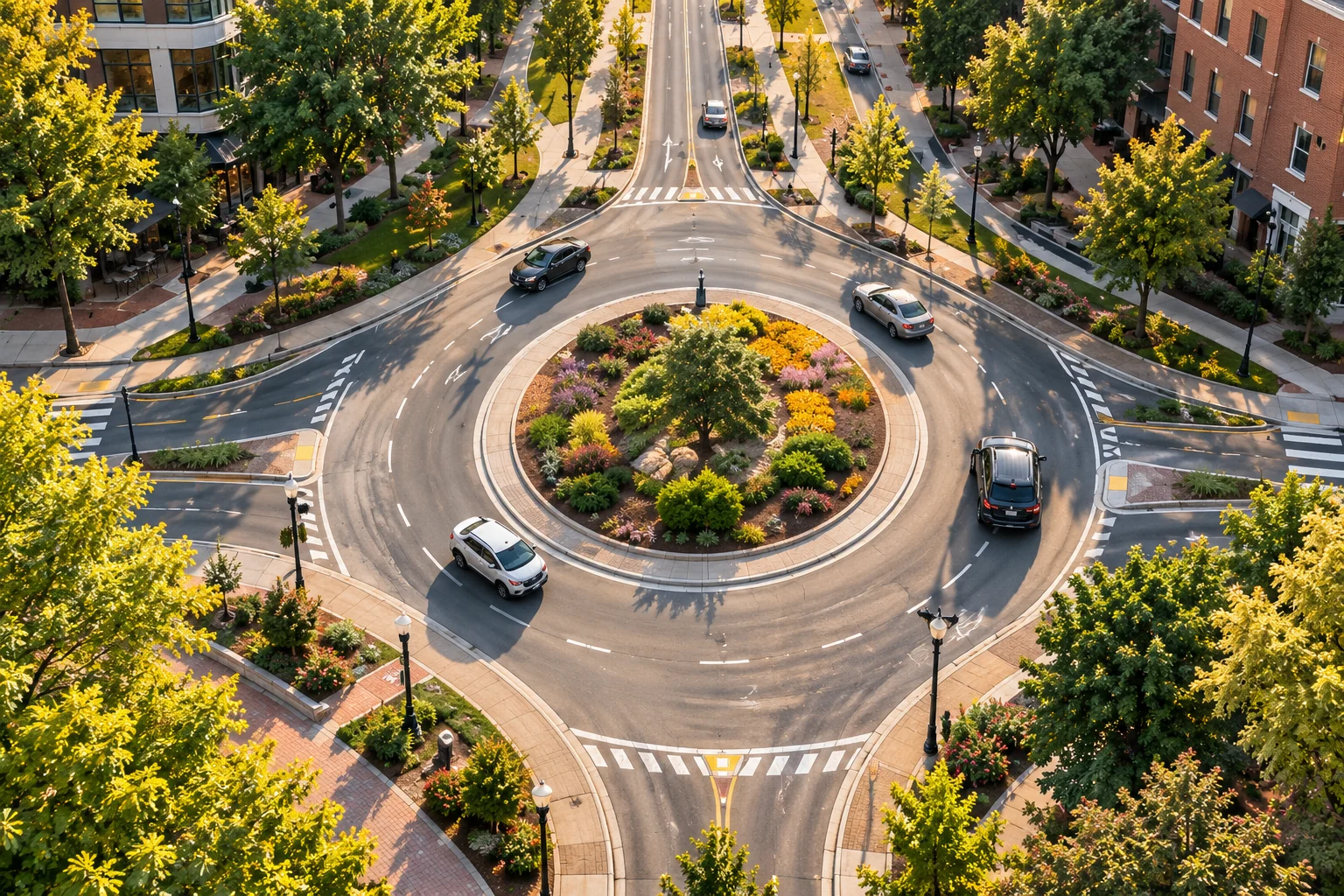
A modern roundabout brings several decisions together: where to enter, which lane to use, when to yield, and where to leave. The useful preparation happens on the approach. Read the signs and lane arrows while you still have time to understand how your intended exit connects with the available lanes.
Understand the basic shape
In the United States, a modern roundabout carries traffic counterclockwise around a central island. Entering traffic yields to traffic already circulating. The FHWA overview of roundabouts explains how curved approaches, lower speeds, and fewer crossing conflicts contribute to the design. A circular intersection is not automatically a modern roundabout; older traffic circles can operate differently.
The island also means the road ahead may not look like an ordinary four-way intersection. Your destination can be on the far side of the circle while your initial movement curves to the right. Following the signs for your destination is more useful than trying to make the layout resemble a conventional left or right turn.
Choose the lane from the actual signs
A single-lane roundabout presents a different task from one with several circulating lanes. At a multilane layout, arrows and approach signs show which lanes serve particular exits. Do not assume that the lane arrangement will match the last roundabout you used.
The Washington State Department of Transportation’s roundabout guide includes instructions for entering, traveling through, and leaving these intersections. Its examples are helpful preparation, while the signs and markings at the actual location remain essential. Select the appropriate lane before entering and follow its marked path.
Include people outside the circle
The circulating roadway is only part of the intersection. Crossings may be set back from the entry and exit, so checking for circulating vehicles does not finish the observation task. Look for people walking or cycling at the approach and again as you leave. Follow the applicable crossing controls and local right-of-way rules.
Large vehicles can also need room that a passenger car does not. Some roundabouts include a raised truck apron beside the central island to accommodate their rear wheels. Leave space for the vehicle’s complete path rather than judging only the position of its front bumper.
Prepare for one unfamiliar junction
- Find the exit or destination you need before beginning the journey.
- Review the approach signs and number of lanes if official route information provides them.
- Expect pedestrians, cyclists, and larger vehicles as well as circulating cars.
- If uncertain about a particular layout, consult the relevant state handbook or transportation agency.
For more on the clues painted onto a road, read what road markings can tell you. For the perspective beyond the driver’s seat, explore one intersection from three viewpoints. A roundabout is easier to understand when its approach, crossings, circulating lanes, and exits are considered together.